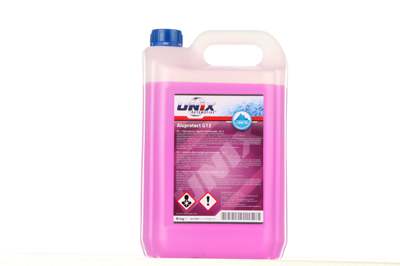
Why is this worth checking now?
At the beginning of autumn, daytime temperatures can still feel pleasantly warm, almost summery, while nights and early mornings are becoming noticeably cooler. The first frosty nights can also arrive sooner than we expect. At this time of year, winter tyres are usually the first thing that comes to mind, but your car’s cooling system deserves some attention too.
The right coolant does more than simply prevent the liquid in the cooling system from freezing in winter. It also helps protect components against corrosion and deposits, while playing an important role in keeping the engine at the correct operating temperature. Before the colder months arrive, it is therefore worth checking both the coolant level and the level of frost protection. Antifreeze products typically provide protection down to around -25°C, making them suitable even for colder parts of Europe.
Coolant or antifreeze – do they mean the same thing?
In everyday conversation, the terms coolant and antifreeze are often used interchangeably, but technically they are not quite the same thing.
Coolant is the liquid that circulates through the vehicle’s cooling system and helps carry heat away from the engine while it is running. Antifreeze is one of its components: it prevents the liquid from freezing at low temperatures and can also contain corrosion inhibitors and other protective additives. In other words, antifreeze is not only important in winter – the correct coolant mixture helps protect the cooling system all year round.
When buying coolant, it is also worth checking whether you are looking at a concentrate or a ready-mixed product. Ready-mixed coolant can be used straight away, while concentrate needs to be diluted with water according to the manufacturer’s instructions. So when it comes to antifreeze, “the more, the better” definitely does not apply.
Blue, green, red or purple – what does coolant colour mean?
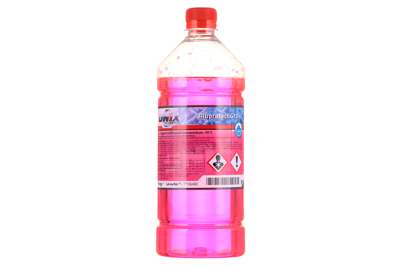
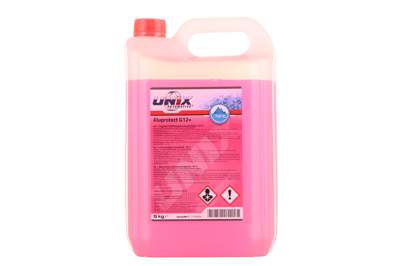
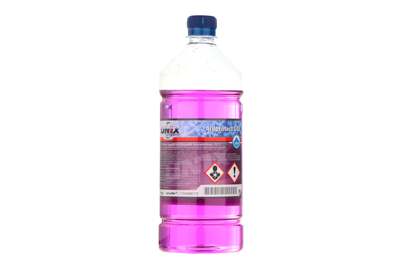
If you have ever looked for coolant in a shop or online, you have probably noticed that it comes in almost every colour imaginable. Blue, green, red, pink and purple are common, but you may also come across yellow or orange products.
Typically, you may see the following colours:
| Specification |
Typical colour |
General guideline |
| G11 |
blue / green |
mainly found in older vehicle designs |
| G12 |
red / reddish-purple |
used in many vehicles newer than those using G11 |
| G12+ |
pink / red |
further development of the G12 specification |
| G12++ |
purple |
also widely used in newer cooling systems |
| G13 |
purple / violet |
used in many modern vehicles |
| HOAT |
yellow / orange |
depends on the manufacturer and specification |
There is, however, one very important rule to remember: never choose coolant based on colour alone.
Coolant colours are not standardised across the industry, which means manufacturers may use different colours for different products. Two pink coolants, for example, do not necessarily meet the same specification. Likewise, if the coolant currently in your car is purple, that does not automatically mean that any purple product is safe to use for topping it up.
For this reason, the best approach is always to follow the specification required by the vehicle manufacturer.
How do I know which coolant my car actually needs?
If colour is not a reliable guide, what should you look for instead? The simplest and safest option is to check your vehicle owner’s manual and look for the specified coolant standard or manufacturer approval on the product packaging. On some cars, this information may also be shown on or near the coolant expansion tank.
When buying coolant, do not focus only on whether the liquid in the bottle is “red” or “purple”. Specifications such as G11, G12, G12+ and others are far more important, along with any requirements set by the vehicle manufacturer.
If you are unsure, it is better to check the correct product using the exact vehicle model, engine version and year of manufacture rather than making a guess based on colour.
If your vehicle requires a G12 or G13 coolant, it is best to look specifically for products that meet the required specification.
Can different coolants be mixed? Better not experiment!
A common question is: if the coolant level is getting low, can you simply top it up with another product of a similar colour? Not necessarily.
Some coolants are compatible with one another, while mixing other types can reduce corrosion protection and, in more serious cases, may lead to deposits or other problems within the cooling system. G11 and G12, for example, should generally not be mixed.
So the same rule applies here as when choosing a coolant in the first place: look at the specification, not the colour. If you are not sure what type of coolant is currently in your car, it is better to find out first than to add another product at random.
There are, however, some exceptions and compatible combinations. If you know exactly which products are already in the system and the manufacturer confirms that they can be mixed, topping up may be possible without draining the existing coolant first.
| Type |
Colour |
Can be mixed with |
Should not be mixed with |
| G11 |
blue / green |
G11 |
G12, G12+, G12++, G13
|
| G12 |
red / reddish-purple |
G12, G12+ |
G11 |
| G12+ |
pink / red |
G12, G12+, G12++ |
G11 |
| G12++ |
purple |
G12, G12+, G12++ |
G11 |
| G13 |
purple /violet |
G12++, G13 |
G11, G12 |
| HOAT |
yellow / orange |
depends on the manufacturer |
G11, G12 |
A quick check before the colder weather arrives
Checking your coolant only takes a few minutes. With the engine cold, take a look at the coolant expansion tank. The fluid level should normally be between the MIN and MAX markings.
You can also check the level of frost protection with a simple antifreeze tester. This gives you an indication of the approximate temperature down to which the current coolant mixture will provide adequate protection.
It is important never to open the coolant expansion tank while the engine is hot. The cooling system may be under pressure, and hot coolant can cause serious burns.
If you notice that the coolant level drops again shortly after topping it up, do not simply keep adding more. Repeated coolant loss may indicate a leak or another problem that needs to be investigated.
One simple rule to remember
Choosing the right coolant can seem complicated at first, especially with so many colours, specifications and product types available. In reality, there is one simple rule worth remembering: always follow the specification recommended by your vehicle manufacturer.
Autumn is a good opportunity to spend a few minutes checking the coolant level and frost protection. That way, the first really cold morning will not catch you by surprise, and your car’s cooling system will be properly prepared for the colder months ahead.
Looking for the right coolant for your car? Browse our range of coolant and antifreeze products and always choose according to the specification required for your vehicle: 👉 Antifreeze at a great price!